

Veteran Services
Honoring The Veteran: A Tribute to Your Veteran
Owens-Ramey Funeral Service is pleased to pay tribute to our veterans and their families. Whatever your vision of military honors, our team of funeral professionals are skilled at accessing services and advising families on available options for veterans.
A military funeral service is available in coordination with any religious or cultural ceremony, including cremation. Choose a volley salute, taps, etc.—our experience with military funerals is vast, and we are privileged to honor those who have served in every branch of the U.S. military.
We do it all, including contacting the cemetery, ordering grave markers, and applying for benefits. Allow us to navigate the government maze for you, with the experience and confidence of a skilled professional. Simply call us at (601) 928-2199.
Below is a brief summary of the veteran benefits and military memorials available to U.S. service men and women. We recommend you contact the VA to become aware of all services and benefits entitled to you and your loved one. Please remember our group of professionals are always available to assist you. You may also access this information directly at the VA website.
Additional help in understanding military funeral benefits can be found at the Military.com website.
Military Funeral Honors (MFH)
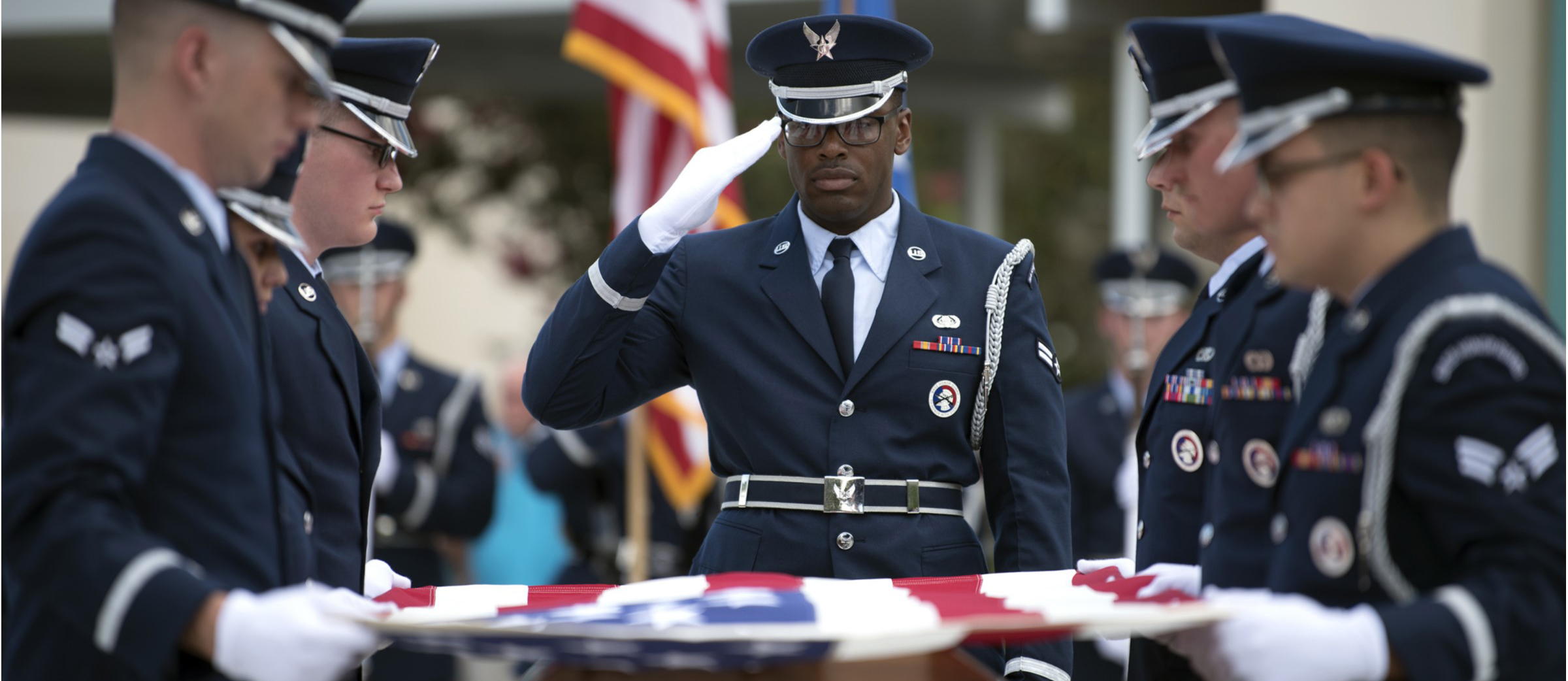
The basic Military Funeral Honors (MFH) ceremony consists of the folding and presentation of the United States flag to the veterans’ family and the playing of Taps. The ceremony is performed by a funeral honors detail consisting of at least two members of the Armed Forces.
The Funeral Honors rendered to you or your veteran will be determined by the status of the veteran. The type of Funeral Honors may be Full Military Honors, 7 Person Detail or a Standard Honors Team Detail.
At least one of the funeral honors detail will be from the Armed Force in which the deceased veteran served. Taps may be played by a bugler or, if a bugler is not available, by using a quality recorded version. Military Funeral Honor Teams may act as Pall Bearers if requested by the veteran/family.
Veterans Headstones
The Department of Veterans Affairs (VA) furnishes upon request, at no charge to the applicant, a Government headstone or marker for the unmarked grave of any deceased eligible veteran in any cemetery around the world, regardless of their date of death. For eligible veterans that died on or after Nov. 1, 1990, VA may also provide a headstone or marker for graves that are already marked with a private headstone or marker. When the grave is already marked, applicants will have the option to apply for either a traditional headstone or marker, or a new device (available spring 2009).
Flat markers in granite, marble, and bronze and upright headstones in granite and marble are available. The style chosen must be consistent with existing monuments at the place of burial. Niche markers are also available to mark columbaria used for inurnment of cremated remains.
When burial or memorialization is in a national cemetery, state veterans’ cemetery, or military post/base cemetery, a headstone or marker will be ordered by the cemetery officials based on inscription information provided by the next of kin or authorized representative.
Spouses and dependents are not eligible for a Government-furnished headstone or marker unless they are buried in a national cemetery, state veteran’s cemetery, or military post/base cemetery.
Note: There is no charge for the headstone or marker itself, however arrangements for placing it in a private cemetery are the applicant’s responsibility and all setting fees are at private expense.
Important Notice – New Law Concerning Eligibility for Headstones and Markers
Veterans Burial Flags
A United States flag is provided, at no cost, to drape the casket or accompany the urn of a deceased veteran who served honorably in the U. S. Armed Forces. It is furnished to honor the memory of a veteran’s military service to his or her country. VA will furnish a burial flag for memorialization for:
A veteran who served during wartime
A veteran who died on active duty after May 27, 1941
A veteran who served after January 31, 1955
A peacetime veteran who was discharged or released before June 27, 1950
Certain persons who served in the organized military forces of the Commonwealth of the Philippines while in service of the U.S. Armed Forces and who died on or after April 25, 1951
Certain former members of the Selected Reserves
Social Security Benefits
Some of the deceased’s family members may be able to receive Social Security benefits if the deceased person worked long enough under Social Security to qualify for benefits. You should get in touch with Social Security as soon as you can to make sure the family receives all of the benefits to which it may be entitled. Please read the following information carefully to learn what benefits may be available.
A one-time payment of $255 can be paid to the surviving spouse if he or she was living with the deceased; or, if living apart, was receiving certain Social Security benefits on the deceased’s record. If there is no surviving spouse, the payment is made to a child who is eligible for benefits on the deceased’s record in the month of death.
Certain family members may be eligible to receive monthly benefits, including:
A widow or widower age 60 or older (age 50 or older if disabled);
A surviving spouse at any age who is caring for the deceased’s child under age 16 or disabled;
An unmarried child of the deceased who is younger than age 18 (or age 18 or 19 if he or she is a full-time student in an elementary or secondary school); or age 18 or older with a disability that began before age 22;
Parents, age 62 or older, who were dependent on the deceased for at least half of their support; and
A surviving divorced spouse, under certain circumstances.
The Social Security website is a valuable resource for information about all of Social Security’s programs. There are a number of things you can do online.
In addition to using the Social Security website, you can call them toll-free at 1-800-772-1213. Staff can answer specific questions from 7 a.m. to 7 p.m., Monday through Friday. They can also provide information by automated phone service 24 hours a day. If you are deaf or hard of hearing, you may call the TTY number at 1-800-325-0778.